


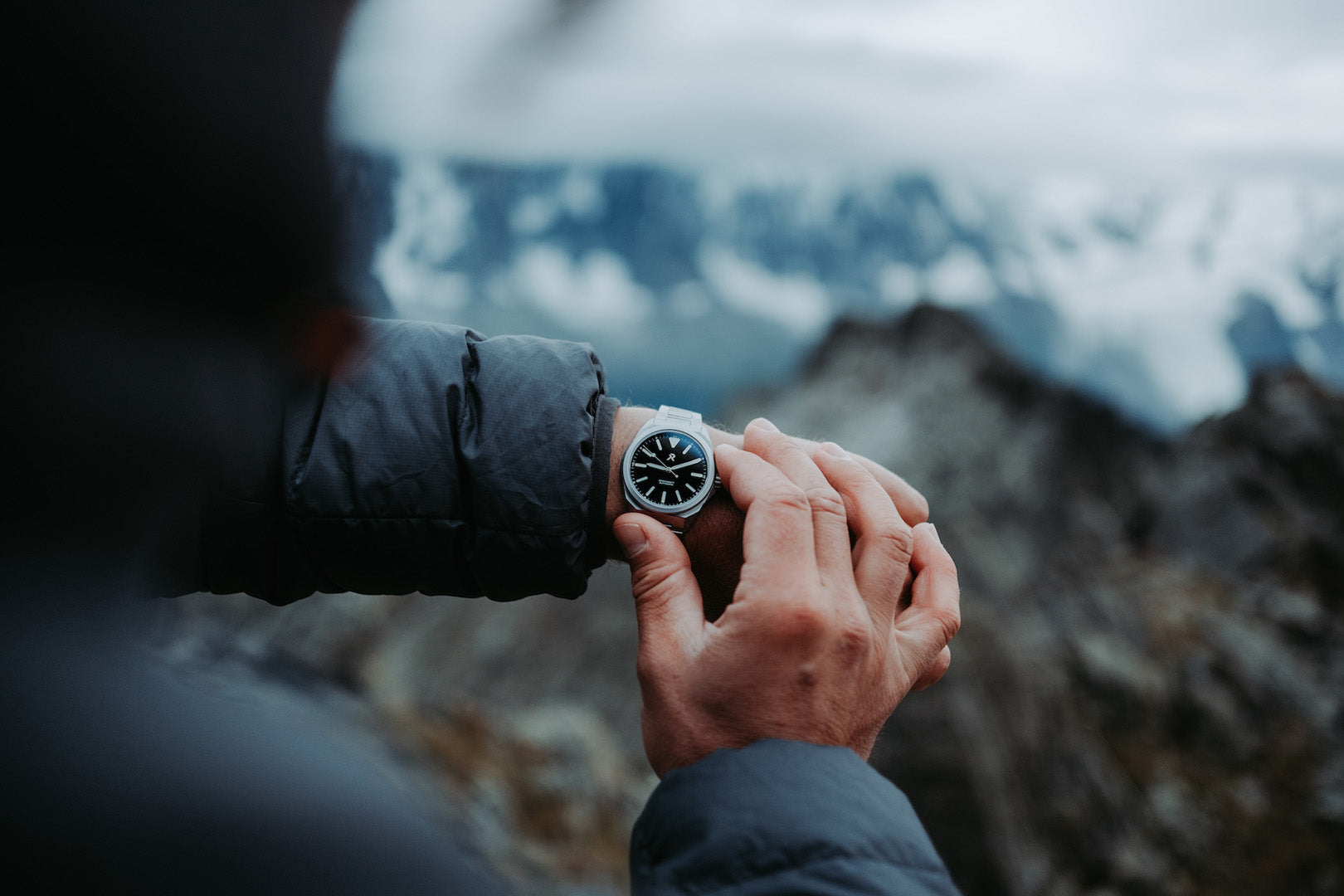




My daughter is fifteen months old. She has no concept of time yet, not in any way I can measure. She knows before and after, hungry and fed, awake and asleep. But she watches everything, and lately I've noticed she watches my wrist.
She doesn't know what a watch is for. To her, it's just a shiny thing her dad touches a lot, something he taps and looks at and occasionally lets her grab. But somewhere in the next few years, she'll start to understand that this object on my arm means something. That it's connected to leaving the house, to dinner time, to when I have to put the camera down and go. And at some point, if I do this right, she'll learn to read it.
That's not a given anymore. A recent report found that as many as 75 percent of kids between six and twelve can't read a clock with hands, a number that would have sounded absurd twenty years ago and now barely raises an eyebrow. Time got outsourced. It lives on a lock screen now, rendered in digits, requiring nothing of the reader. No estimation, no spatial reasoning, no sense of time as something that moves rather than something that simply is. A phone tells you it's 4:47. A watch makes you understand you're most of the way through the hour and running out of light.
I think about this more now that I have a kid who's actually watching how I move through the world. Wearing a mechanical watch around a toddler is a strange, quiet kind of teaching. She sees me check it before we leave for a walk. She sees me wind it some mornings, this small ritual that clearly matters to me even though she has no idea why. Kids absorb behavior long before they absorb explanation, and I'd rather she absorb "time is something you read and respect" than "time is something that pings at you."
There's also the object itself, separate from the skill. A phone is replaced every two or three years and forgotten the moment it's traded in. Nobody hands down an iPhone. But a well-made watch, one built to actually survive use rather than sit in a drawer, can outlast the person who bought it. I've got a few pieces in my own collection now that have taken real knocks over the years and still run fine, still look like they've earned the marks rather than been ruined by them. There's something appealing about the idea that a watch keeps working long after you've stopped needing it, and that eventually it ends up on someone else's wrist, someone who wasn't around for any of the trips it's already been on but inherits the wear anyway. A watch with history means something that a new one straight out of the box doesn't. My daughter won't care about that at fifteen months. She might care a great deal about it at thirty.
None of this is really about telling time in a practical sense. Realistically, she'll grow up with a phone in her hand and always know the time without trying. This is more about what the object represents. A watch asks something of you, even if it's small. You have to look, interpret, and do a tiny bit of mental work to translate hands into minutes. That's a different relationship with time than glancing at a number that's already been calculated for you. One local study found that only about a third of kids can even read an analog clock anymore, and mind you, this is an old study, not a recent one, which says less about kids and more about how few adults around them are still modeling the skill.
So I keep wearing mine. Not as a statement, just as a habit I want her to grow up around. Eventually, I'll teach her to read it properly, the same way someone probably once sat me down with a cheap plastic clock face and moved the hands until it clicked. And somewhere further down the line, there's a decent chance the watch on my wrist right now is still ticking along when she's old enough to want it for herself.
 That's a strange kind of gift to think about when she's still working on standing up unassisted. But it's the kind of thing that only makes sense in hindsight, and I'd rather start now than wonder later why I didn't.


