



There's a moment most hikers know well. You're an hour into the trail, the treeline has opened up, and the view ahead is worth every blister. Then your phone buzzes. A notification. Maybe two. And just like that, the mountain shrinks a little.
It's not that technology is the enemy of adventure. GPS has saved lives. Weather apps have turned back expeditions that would have ended badly. But there's a growing tension between the connected world we carry in our pockets and the disconnected freedom we seek outdoors. Somewhere in that tension, the humble wristwatch has quietly become one of the most radical tools an adventurer can own.
The Phone Problem No One Talks About
We reach for our phones to check the time more than almost anything else. It sounds trivial until you realize what comes with it. A glance at the clock becomes a scroll through messages, a check of the weather, a detour into a notification spiral that pulls you miles away from wherever you actually are mentally, at least.
For adventurers who head into the wild specifically to escape that noise, the irony is sharp. The device you brought for safety becomes the thing undermining the entire point of being there.
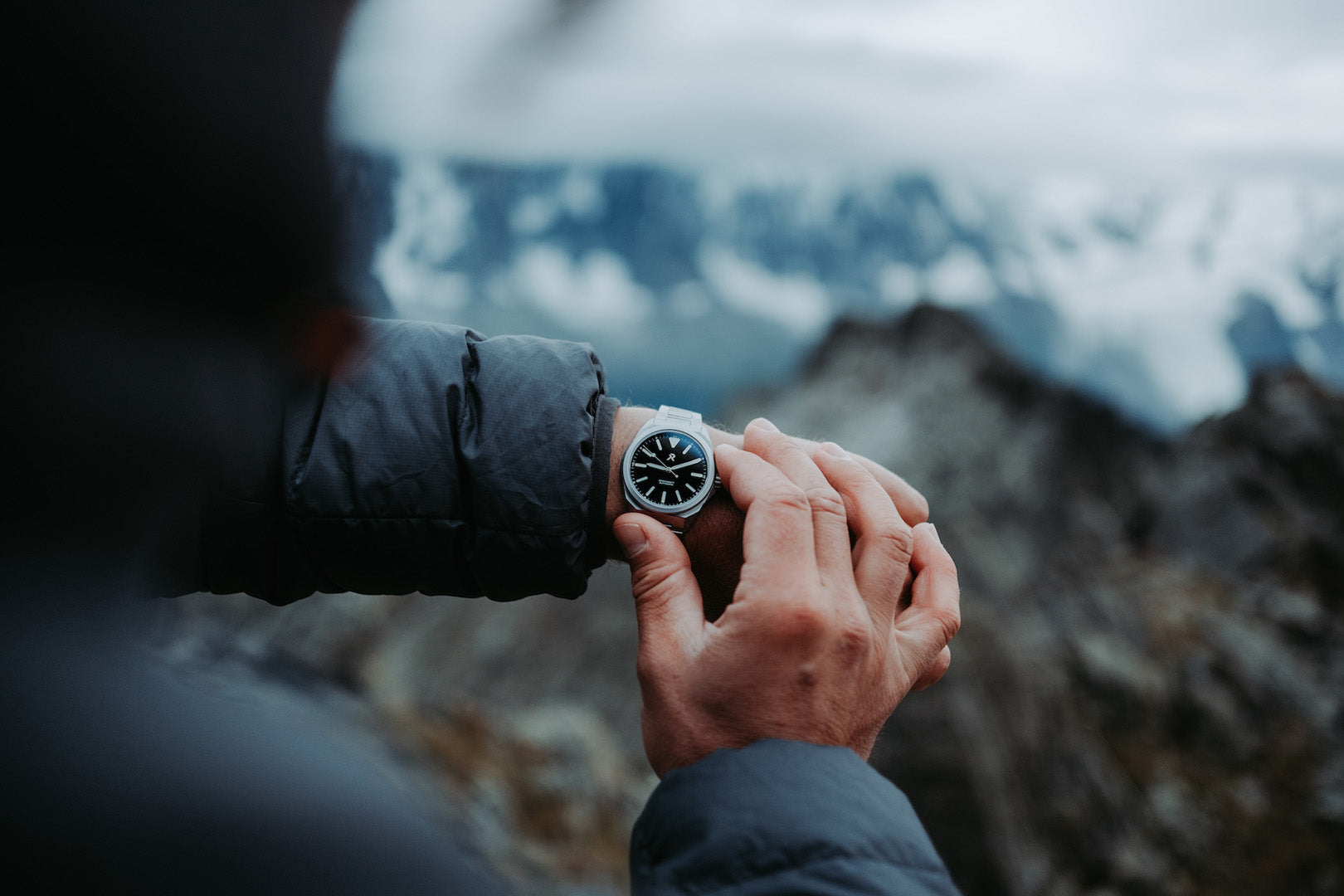
RZE adventurer Dion VanBoekel put it: on long hikes, he looks to his watch to track time so he can stay present, eyes forward, focused on reaching the summit before sunrise and back to the trailhead before dark. No detours. No distractions. Just the information he needs, exactly when he needs it.
That's not nostalgia. That's intentional design for how a human brain actually works best in the field.
Analog in an Age of Algorithms
There's something worth examining in why a mechanical or quartz dial with two hands and a rotating bezel feels so different from a screen. Partly it's physical. A watch delivers one piece of information and steps aside. It doesn't compete for attention. It doesn't learn your behavior and optimize for engagement. It simply tells you the time and trusts you to do something useful with it.
For adventure, that restraint is a feature, not a limitation.
A pilot reading elapsed time on a bezel, a diver tracking bottom time, a trekker calculating daylight left before camp, these are all acts of focused, present-tense thinking. The watch is a prompt to engage with where you are, not where your feed wants to take you.
The Weight of What You Carry
There's also something to be said about the physical commitment of wearing a watch. Strapping something to your wrist before a climb or a dive or a long-haul trail run is a small, deliberate ritual. You're equipping yourself. You're acknowledging that the adventure ahead deserves a tool built for it.
A good example is our Valour 38; at 57 grams of solid titanium, a well-built field watch doesn't ask much of you physically. But it gives back a kind of clarity that no smartphone notification setting ever quite manages. It's always on. Always legible. Unaffected by a dead battery at altitude or a cracked screen on a scramble. It doesn't need a signal to tell you that you have two hours of daylight left.
That reliability creates trust. And trust, out in the field, is everything.
Presence as a Practice
The adventurers who talk most passionately about wearing a watch rarely lead with specs. They lead with feel. Checking a bezel becomes second nature. The way a glance at the dial keeps them in rhythm with the environment rather than pulling them out of it. The way, at the end of a long day in the mountains, they can't remember the last time they thought about their inbox.
That might be the most underrated thing a watch does. Not to measure time, but to manage attention.
In a world engineered to fragment your focus, choosing an analog tool is a quiet act of defiance. It says: I'm here. This is where I want to be. And I have exactly what I need on my wrist to stay that way.
Are you an adventurer who's made the switch from phone to watch on the trail? Tag us with your story using #AssembledForAdventure.


