


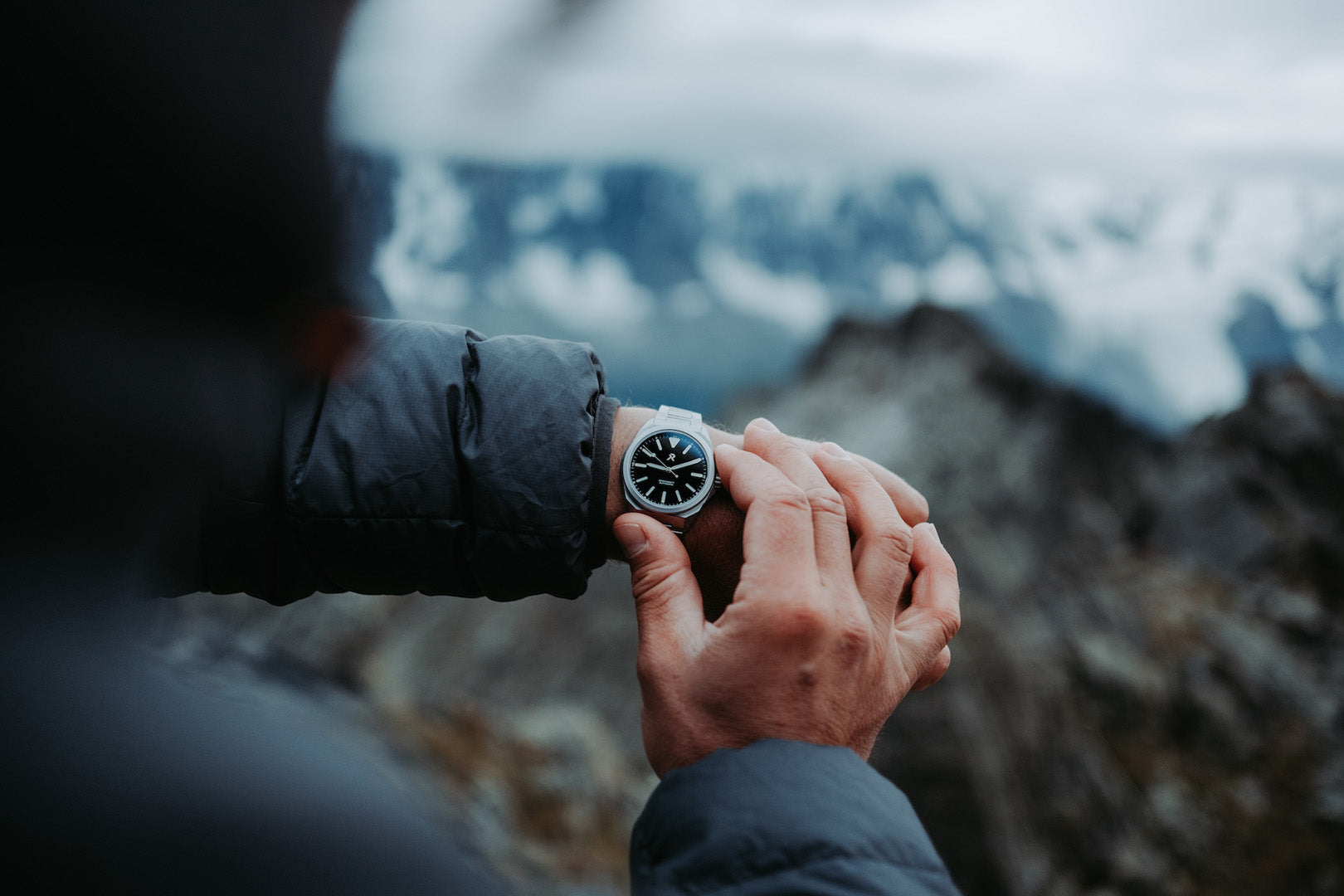



There's a quiet revolt happening on the wrists of serious outdoor people, and the tech industry hasn't noticed yet.
While Apple and Garmin race to add more metrics, more notifications, and more reasons to stare at your wrist mid-trail, a growing number of hikers, backpackers, and field enthusiasts are strapping on something decidedly lower-tech: a simple analog field watch with a canvas strap, a clean dial, and zero desire to tell you how stressed you are. This isn't nostalgia. It's a corrective.
When GPS smartwatches took over the outdoor gear conversation, the pitch was compelling: navigation, fitness metrics, heart rate, sleep tracking, notifications, even SOS capability, all on your wrist. For a certain kind of adventure, that capability is genuinely useful. Nobody is arguing that you should swap your Garmin Enduro for a Hamilton Khaki on a technical alpine route. But for the vast majority of people heading into the outdoors, day hikers, backpackers, and trail runners on familiar terrain, the smartwatch has quietly become a liability. It vibrates when your phone gets a message. It nudges you to stand up. It turns every walk in the woods into a data collection exercise. The trail becomes a backdrop to your biometrics rather than the point of being there.
The outdoor experience, at its core, is about getting out. Out of your routine, out of your inbox, out of your own head. A watch that imports that world onto your wrist defeats the purpose.

The field watch was never designed to do more. It was designed to do less. reliably, durably, and without asking anything of you in return. Born out of military necessity over a century ago, it emerged with a clear brief: legible dial, robust case, accurate movement, nothing extraneous. That design language has remained largely unchanged because it was right from the start. It tells you the time. It tells you the date. In low light, the lume handles both without the theatrical wake-up swipe of a smartwatch screen. There's a reason outdoor enthusiasts who've spent real time in the field consistently reach for analog over digital. The field watch keeps your focus where it belongs. On the landscape, not the data feed. That's not a minor psychological nicety. It's the entire point of going outside.
What's notable right now is that this shift isn't just anecdotal; it's showing up in the market. New releases like the Timex Expedition Capstone, a classic field watch powered by a Japanese automatic movement, prove that appetite for this category remains strong and that buyers want modern reliability wrapped in a traditional package. Not a smartwatch with an analog face. An actual field watch, engineered properly, that happens to be new. At Watches and Wonders 2026 in Geneva, the watch industry's most important annual showcase, the dominant themes were a return to archival designs, smaller case sizes, and vintage aesthetics. The industry's most sophisticated tastemakers are moving away from excess and toward intention, credibility over visibility. That's the field watch ethos, expressed in luxury terms. Even the broader data support it. The share of people who wear a mechanical watch daily has dropped sharply over the past five years, but that's not because people have stopped valuing analog timekeeping. It's because smartwatches are the default category. The people actively choosing a field watch now are doing so deliberately, which makes its resurgence more meaningful than any raw sales number.

That's because this is about more than watches. The field watch revival is part of something larger, a growing rejection of the idea that more data equals better experience. We're living through peak quantification. Sleep scores, recovery metrics, readiness percentages. The wellness industry has convinced an entire generation that the path to feeling better runs through measuring everything. And for a subset of people, in specific contexts, that's true. But there's a counter-movement building, and it's finding expression in objects. The resurgent interest in paper maps, handwritten field notes, manual cameras, and analog watches isn't Luddism. It's a deliberate preference for tools that demand presence rather than consumption. A field watch doesn't need charging. It doesn't need a companion app. It doesn't collect your data. It just works, every time, for decades. That kind of reliability is itself a form of sophistication. One that the smartwatch industry, for all its engineering talent, cannot replicate.
So if you've been defaulting to a GPS watch for every outdoor outing because that's what the gear conversation told you to do, it's worth asking whether you actually need it. If you're not navigating unfamiliar terrain, not running structured training, and not in a situation where SOS capability is a genuine need, the field watch does everything you actually require. It tells time. It doesn't distract you. It lasts for years on a single battery or winds itself on your wrist. It survives everything you can throw at it.

And increasingly, it makes a statement. In a gear culture obsessed with specs, wearing something that refuses to compete on those terms is its own kind of confidence.
The gear community is quietly voting with its wrists. The field watch is winning. And smartwatches, for all their impressive hardware, still can't give you back the thing a field watch never took away in the first place.
Your attention.


