





Type A: Clarity, Stripped Back
The Type A dial is the purist’s layout. It consists of large Arabic numerals 1 through 11, with a triangle at 12 o’clock flanked by two dots. No outer track stealing attention. No hierarchy of information. Just one clean circle of hours and the minute hand sweeping over them with authority.
It’s legibility distilled. In the finest way possible.
This design traces back to the German Beobachtungsuhr (B-Uhr) issued in the 1940s, produced by brands like A. Lange & Söhne, IWC, Laco, Stowa, and Wempe. The brief was simple: make something a navigator could read instantly in turbulent conditions.
I’ve always felt Type A wears smaller than its measurements. Even modern interpretations at 40–42mm feel composed. Balanced. Almost architectural. There’s nothing competing for attention. The hour hand is king, and the rest falls in line.
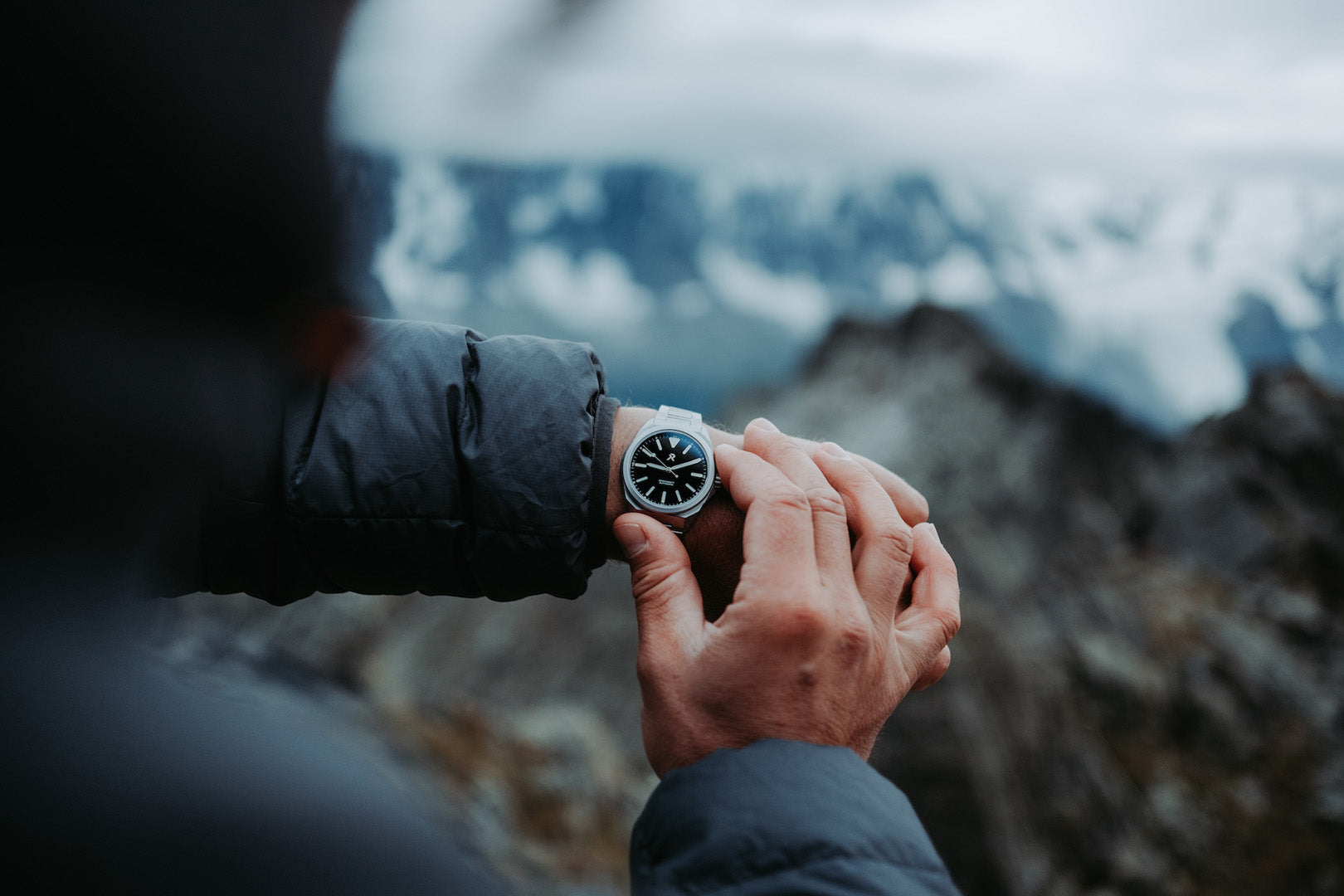
For everyday wear, Type A feels effortless. You glance down while juggling a camera bag or adjusting your kid’s jacket before school, and the time reveals itself without drama. It’s not trying to prove its aviation heritage. It simply carries it.

Our interpretation of the Resolute Type A pays tribute to its origins by incorporating our design language with subtle angles and textures, complemented by our UltraHex™ technology. This ensures the pilot watch is highly durable, utility-focused, and stylish on the wrist.
Type B: Precision First
The Type B dial is where things get more technical.
At first glance, it looks busier. The outer track features large minute numerals—5, 10, 15, all the way to 55—while the hours shrink into a smaller inner circle.
It’s deliberate. In flight navigation, minutes mattered more than hours. Calculations, timing legs of a journey, fuel estimates—precision was everything. The minute hand becomes the hero here, long and assertive, often stretching right to the edge of the dial.
Type B feels more like an instrument than a watch.

On the wrist, it demands a second look. Not because it’s confusing, but because your brain instinctively reads the larger outer numerals first—minutes before hours. It’s a subtle shift, but one that reminds you this was built for a cockpit, not a boardroom.
There’s a quiet charm to that slight awkwardness. It feels specialised. Purpose-built. Honest.
I personally love the style of Type B watches, as they can look sophisticated and elegant when done right, just like our RZE Fortitude Series.
Design Details That Matter
However, beyond the numerals, both Type A and Type B share core traits:
-
High-contrast black dial and white markers for maximum legibility
-
Oversized onion crown, originally designed to be operated with gloves
-
Minimal branding, sometimes none at all
-
Long, sword-style or cathedral hands, often heavily lumed
The triangle at 12 isn’t decorative—it’s a fast orientation marker. In low light, you instantly know which way is up. It’s a small detail that speaks volumes about intent.
So, which One Feels Right?
This would probably be one of the first questions that you would have if you're getting your first pilot watch. Type A is cleaner. More versatile. Easier to live with daily. Whereas Type B is more historically accurate to later B-Uhr specs. More instrument-like and slightly more serious.
If you’re drawn to symmetry and restraint, Type A will likely resonate. It’s the one that disappears into your routine in the best possible way.
If you appreciate function-forward design and don’t mind a dial that makes you pause for half a second longer, Type B feels more intentional—almost defiant in its practicality.
Having seen and owned both styles, I can only conclude that your preference shifts with where you are in life. When I wanted simplicity, I leaned toward Type A. When I wanted something that felt like equipment rather than an accessory, Type B made more sense.
Neither is better. They’re just two interpretations of the same sky.
And maybe that’s the beauty of pilot watches in general—they remind us that design, at its best, is never about decoration. It’s about clarity. About purpose. About knowing exactly what you need and removing everything else.
The rest is just altitude.


